

2014/08/31 Amazing news! One year standing - Less than 6% self-discharge rate! (MPB series product)
Self-discharge Test Report - MPB-02
Less than 6% one year self-discharge rate!
(from 2013.08.22 to 2014.08.29, totally 373 days)
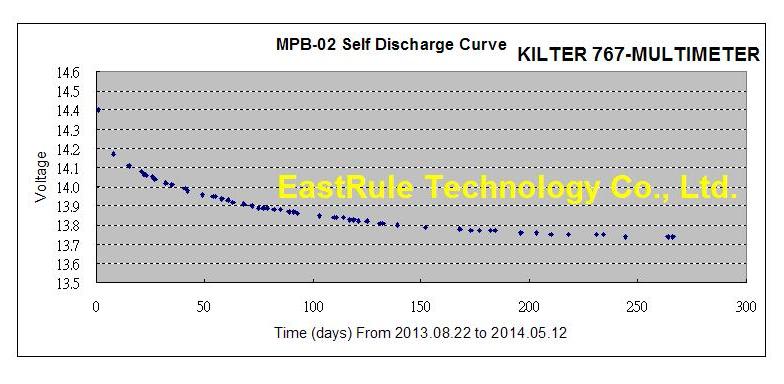
MPB series product has a very low self-discharge rate. To verify the rate of self-discharge , we prepared 10 sets from 2013.08.22 to 2014.08.29 and placing there at the turn-off mode. Every 7 to 10 days, we measured the voltage of the same device(MPB-02) and recorded it. The steps of measurement are listed as below, and the multi-meter is KILTER 767. We always use the same meter to keep the data objectively.
Step 1: Turn on the main switch;
Step 2: Press the 12V-Output push button (Reset Button);
Step 3: Measure the voltage of Anderson Connecter poles and record the value.
Step 4: Turn off the main switch.
To avoid the power loss caused by MCU during operation, (When the main switch is turned on, the MCU of MPB-02 starts to work), we have to finish measuring in 5 seconds to keep the data objectively.
Table below shows the self-discharge of MPB-02 from 2013.08.22 to 2014.08.29. (373 days)
At the first day, MPB-02 was charged to 14.5V by the adapter (automatic cut-off). After 373 days later, the voltage of MPB-02 dropped down to 13.65V.
The self-discharge ratio of the past 373 days is calculated as: (14.5-13.65)/14.5 = 5.86% (0.49% per month)
Less than 6% one year self-discharge rate!
(from 2013.08.22 to 2014.08.29, totally 373 days)
MPB series product has a very low self-discharge rate. To verify the rate of self-discharge , we prepared 10 sets from 2013.08.22 to 2014.08.29 and placing there at the turn-off mode. Every 7 to 10 days, we measured the voltage of the same device(MPB-02) and recorded it. The steps of measurement are listed as below, and the multi-meter is KILTER 767. We always use the same meter to keep the data objectively.
Step 1: Turn on the main switch;
Step 2: Press the 12V-Output push button (Reset Button);
Step 3: Measure the voltage of Anderson Connecter poles and record the value.
Step 4: Turn off the main switch.
To avoid the power loss caused by MCU during operation, (When the main switch is turned on, the MCU of MPB-02 starts to work), we have to finish measuring in 5 seconds to keep the data objectively.
Table below shows the self-discharge of MPB-02 from 2013.08.22 to 2014.08.29. (373 days)
At the first day, MPB-02 was charged to 14.5V by the adapter (automatic cut-off). After 373 days later, the voltage of MPB-02 dropped down to 13.65V.
The self-discharge ratio of the past 373 days is calculated as: (14.5-13.65)/14.5 = 5.86% (0.49% per month)
Every time we measured the voltage of MPB-02 (the same one) by the same multimeter: KILTER 767.
As we confirmed the voltage of MPB-02 was 13.65V, we used this MPB-02 to start the vehicle: SAAB 95 2.0t (2009) without any battery. It worked as we expected. It was a fairly successful experiment. That means that after standing one year, MPB-02 still has more than 94% effective capacity to provide the vehicle to start the engine!
2024-10-24